Showing posts with label Latin Mass. Show all posts

Monday, April 12, 2010

Real Priests, we have it so easy today

How sad the poor people in attendance could not participate, they were so deprived and didn't even know it. Bet they appreciated it more.

The Egyptian
From the Crescat.

mass in Bataan...

Sunday, March 21, 2010

The Stuff Priests Are Made Of

I bet it wasn't in English either, pity the soldiers couldn't get anything out of it ;>)


The Egyptian

defend us in battle... from the Crescat

...With a canvas tarpaulin for a church and packing cases for an altar, a Navy chaplain holds mass for Marines at Saipan. The service was held in memory of the brave men who lost their lives in the initial landings. Photo by Sgt. Steele, June 1944. Source: US Marines.

Sunday, January 24, 2010

Leonine Prayers explained

great new blog, always wondered how some prayers started, well the Leonine Prayers are explained here
the Egyptian

from: Let The Welkin Ring

St Michael Archangel

On October 13th, 1884, Pope Leo XIII had a remarkable vision. When the aged Pontiff had finished celebrating Mass in his private Vatican chapel, attended by a few Cardinals and members of the Vatican staff, he suddenly stopped at the foot of the altar. He stood there for about ten minutes, as if in a trance, his face ashen white. Then, going immediately from his chapel to his office, he composed the prayer to St Michael, with instructions it be said after all Low Masses everywhere. When asked what had happened, he explained that, as he was about to leave the foot of the altar, he suddenly heard voices – two voices, one kind and gentle, the other guttural and harsh. They seemed to come from near the tabernacle. As he listened, he heard the following conversation:

The guttural voice, the voice of Satan in his pride, boasted to Our Lord:

“I can destroy your Church.”

The gentle voice of the Lord:

“You can? Then go ahead and do so.”

Satan:

To do so, I need more time and more power.”

Our Lord:

“How much time? How much power?”

Satan:

75 to 100 years, and a greater power over those who will give themselves over to my service.”

Our Lord:

“You have the time, you will have the power. Do with them what you will.”

That was Pope Leo's vision in 1884. Satan said that he needed between 75 and 100 years. 75 years onto 1884 brings us to 1959 (incidentally, the year of my ordination!) and in the January of that year Pope John XXIII called the Second Vatican Council. Just about the first thing to come from the deliberations of the Council Fathers, which began in earnest in 1963, was the abandonment in 1964 of the Leonine Prayers, the prayers at the end of Mass which called St Michael to the aid of the Church on earth.

In the years from 1959 to 1984, judge for yourselves whether Satan has kept his promise to destroy the Lord’s Church. Of course, the Lord’s Church can never be destroyed altogether. But, ask yourself, if you are old enough to remember, were parish churches fuller in 1984 (and since) than in 1959? What happened to parish societies, like the SVP and the Legion of Mary, in that time? Has the Church been more united in worship? Are we more united in doctrine than ever before, or is everyman his own Pope now?

One particular loss of belief which we have suffered is the belief in Satan and his awful army of devils who seek to destroy our spiritual life with God. I love to say the Leonine Prayers whenever I can, and I hope and pray that some day they will be re-instated at the end of every Mass which is celebrated.

Thursday, November 26, 2009

Timespace Liturgy

From Smaller Manhattans Thanks
this is the best description of the Mass I have read, what a CCD teacher, she deserves an award, no touchy feely happy clappy crap, just the mystery that is so lacking in our worship, The Latin Mass so captures this where the Novus Ordo meal falls flat, enjoy
The Egyptian


One of the key concepts in 6th grade Wednesday Sunday School is that our worship at Mass connects directly, physically to the unceasing worship that goes on in Heaven. I use the term 'Holy Tornado' along with some blackboard sketching to show a temporary timespace continuum between Heaven and Earth. (see Trou de Ver) Our prayers go up, zhhhhhpp! Jesus comes down, shhhhhhp! Then after a few minutes, bzhht! the connection is broken until the next Mass. The kids dig the science-fiction-movie sounds.

I use this line from Eucharistic Prayer I to reinforce the point:

“Almighty God, we pray that your angel may take this sacrifice to your altar in Heaven.” Until now I've always drawn this concept on the board. From now on I also have some art to show.

Look at that great image I stumbled upon recently at Tiber Jumper's blog. It differs from similar Mass pictures I've seen since my pre-Vatican 2 childhood. In addition to the crucified Christ made present, it shows an angel ascending to heaven in the midst of the Mass. I imagine the painting is directly inspired by that line from the Eucharistic Prayer, which itself must be partially inspired by descriptions in Revelations of activities around the altar in heaven, e.g., 8:3-4 which is covered in class:

"And another angel came and stood at the altar, having a golden censer; and there was given unto him much incense, that he should offer it with the prayers of all saints upon the golden altar which was before the throne. And the smoke of the incense, which came with the prayers of the saints, ascended up before God out of the angel's hand."

And check out the upper half of the image....the angel is being caught up (raptured!) by the swirling timespace winds of the Holy Tornado! Who knew?!

If anything beats catechizing 6th grade I want to know what it is.

Wednesday, September 2, 2009

Total Faith In GOD

forgot where I got this but the bravery and FAITH of the priests in WWII is beyond compare, really people are so soft today

The Egyptian

Once there was a time...

I told this story at dinner the other night. The family liked it, and Puff told me I should write it out on the blog. Like most of my best stories, it isn't my story at all, but my father's, and like many of his best stories, it's from the war.

Dad was at or near the front lines in Italy one day when an officer came down the line. "Any Catholics here," he began. "There's a priest about to say Mass in the next field." Dad took his helmet and rifle and headed over to the next field, as did several other Catholics.

He was appalled when he arrived. The field was wide open, easily visible from the Germans, and exposed to any kind of enemy fire. The men immediately looked for a hill, a shell hole, a rock, a furrow- anything that might give them any sort of cover. Meanwhile, in the middle of the field stood the priest, carefully setting up his Mass kit on a big rock, taking his time and doing it properly, appearing as if he had no concern in the world other than this, and going about it as if he were in a parish back home, and there was no war to trouble anyone or anything.

If there was ever a time for a Tridentine speed Mass, this could have been it. But, to Dad's horror, (and he knew, because he used to be an altar boy at a Cathedral) the priest said the Mass slowly and carefully, doing every movement as prescribed, omitting no prayer, while gunfire raged around them.

At last the priest turned, holding the consecrated host. "Come to Communion!" he shouted out to the men hiding in the field. "I grant you all full absolution. Come!"

Dad's reaction was: "He's got to be kidding." But then he saw it: the soldiers making their way forward to receive communion. Granted, they approached the priest at a dead run, and left at a dead run as soon as it was received. But still they came. Dad, emboldened by the other men, came forward himself, received, thanked God, and raced away.

He stayed in his furrow watching as the priest put away his Mass kit as properly as he set it out, and, when finished and having said his final prayers, the priest snapped his case shut and walked away.

That's the story. Not the best punch line, but the family liked it. I like it for it reminds of a good man I once knew and shall never see again in the flesh. It reminds me that there were other good men like him, once upon a time. Men who believed there were things to stand for, things to fight for, things that were worth risking your life for. And on that list of things worth risking your life over was Mass, and the chance for Communion.

Friday, August 21, 2009

TLM ‘Horizontal Proof’

(giggle-snort) dang, spilled coffee on my key board again, too funny but so true

The Egyptian

The Death of ‘Me-Church’ by Steve Skojec

This past Sunday, as I attempted to get my wriggling, squeaking, squirming children settled in our pew for what usually amounts to a liturgical rodeo — see if you can keep them on their best behavior for eight seconds without getting thrown out of the church — I noticed the arrival of two women in their sixties who clearly looked like they did not belong. Processing up the aisle in search of a seat, they were dressed very casually, with the short-cropped, boyish, almost intentionally unattractive hairstyles that seem to be de rigeur for the aging members of America’s post-feminism movement. They stood out in a sea of suits, ties, dresses, and chapel veils.

Far be it from me to judge based solely on appearances, of course: I may be a Trad, but when I know I’m going to be wrestling with toddlers for the duration of an hour-and-a-quarter-long Mass in the heat of the summer, I’m the first to arrive in a polo shirt instead of an oxford. Even so, sometimes it’s just true: “By their fashions you will know them.”

This daring duo of anti-patriarchalism might have been guests in from out of town and staying in the hotel across the street, unaware that the 9 a.m. Mass at this particular parish is, in fact, a throwback to the glory days of Catholicism, before the option existed to replace all the masculine pronouns for God in the liturgy with gender-inclusive ones. Might have been, I say, but for the fact that they gave themselves away with their refusal to kneel during such unimportant moments of the Mass as, say, the consecration. They stood like Amazon warrior priestesses at attention, forming a phalanx to defend the rear guard of fruit-loopy Catholicism’s last hoorah.

As I looked at them (they were partially blocking my view of the altar, so I couldn’t help it), I felt not my usual twinge of irritation at the guardians of “Me-Church,” but instead a kind of amused pity. They couldn’t perform their non-conformist schtick, mad-libbing their way through responses that, in Latin, they couldn’t understand. Hindered by the liturgical language barrier and unfamiliar with the posture of the priest, they were also unable to determine when to hold hands inappropriately during the “Our Father” and were ritually deprived of the showy displays of human affection afforded them by the Sign of Peace.

In other words, the liturgical experience in which they found themselves was horizontal-proof. It resists by its very essence all efforts to make it conform to Man. Instead, within its confines, man (or womyn, if you prefer) must conform to God.

As I watched the priest, his attention turned to the altar and, incidentally, away from their awkward and ineffectual protest, I felt certain that I was at last seeing the death of an ideology that had long outlived its time. The parish was full — not just with gray-haired hangers-on, but with young families teeming with small children, all of whom demonstrated a deep fondness for tradition, ritual, and respectful worship. The visitors’ triumphalistic “We Are Church” mentality was made irrelevant by a more humble, less self-conscious Catholicism. The people around them were far less concerned with having the attention focused on them, and far more concerned with keeping children quiet and well-behaved, and making it through the confession line before Communion time.

This reality is not restricted to the extraordinary form of the Mass, though it finds much substance there. As the Church turns with a view to the past, not just the future, and admits more of its once-abandoned orthodoxy back into its liturgies, the revolutionaries who sought to remake Catholicism are growing old and fading away. The Church is timeless and seems now, at last, to be maturing out of its bi-millennial identity crisis. It is a Catholicism that remembers what it was and where it is going — to Our Father’s house — where the choirs of angels sing not their own praises but His, forever and ever.

Saturday, August 15, 2009

from the New York Times, letter to the editors

first paragraph is a good comparison, and last two help explain, forgot how I received this but to good to delete.

Enjoy
The Egyptian

As far as the Church is concerned, I think that there was a period of collective drunkenness, starting with the excesses of good wine with V II itself and continuing with the ocean of vodka of “the spirit of V II”. The top (the Vatican) has sobered down relatively fast and in 1978 sobriety was firmly in charge within the conclave, but there was no courage to eradicate bad habits among the generation of guitar-strumming alcoholics who in the meantime had spread all over Catholicism, starting from the bishops.
What I think is happening is that from above (the Vatican) Chianti Classico is slowly being introduced again, but that it will never establish itself as a habit among those who have spent a life amidst bloody marys and alcopops.
Whilst I think that a bigger effort should be done to kick out some of the worst offenders (the South of England being a point in case), I do understand that there is no great desire at the top to start fights when, as a famous drug addict once said, “time is on our side”.
——-
What the NYT readers might be helped to understand by this article is that as JP II was an improvement on Paul VI and BXVI is a big improvement over JP II, Benedict’s successor will be an improvement on him and will feel free to continue his work of sobering down the trendy masses with greater energy, and his successor more than him. This is what the future will bring and they’ll better get accustomed to the idea now.
————————————
I see far brighter days ahead, and the Holy Ghost silently and slowly, but steadily working on the necessary repairs of Peter’s Barque: vocations clearly come from the conservative side and the hippies are utterly despised among the younger faithful, whilst the Anglicans disintegrate worldwide and show once again the destiny of every man made “church”.
In an age of “freedoms”, more and more people discover that what they want is guidance; the Catholic church has never been so well regarded even in the protestant world and nowadays a Protestant President of the United States dares to be present at a Pope’s funeral, his brother a Catholic convert! In time, the Catholic Church will be seen by more and more people as the only alternative, whilst many Protestants drown in an ocean of political correctness making them less and less recognisable as Christians.
If you ask me, the future belongs to conservative Protestants and Catholics. All the others will end like the dinosaurs.
—-

Wednesday, August 5, 2009

follow the Popes orders, PLEASE

Saturday, August 01, 2009

Vatican tells bishops to implement Motu Proprio

Guido Pozzo, the new secretary of the Pontifical Commission "Ecclesia Dei "

The Pope asks bishops throughout the world to follow his instructions about the so-called old rite of the Mass. "The local bishop must adhere to the directives "which concern the extraordinary rite of the Mass, writes the new secretary of the Pontifical Commission "Ecclesia Dei", Guido Pozzo, in a letter that the Internet portal "messainlatino.it" has published. "If in a diocese, there are a significant number of believers who wish for the older rite, they need no special permission from local bishop" writes Pozzo, according to the website. The bishop should instead "examine" how this desire is to be "effectively implemented". He should not specify the number of believers who are asking for the rite which are to be "significant", which depends very much on "local circumstances"

Tuesday, August 4, 2009

great commentary by Fr Martin Fox

From Bonfire of the Vanities

Monday, August 03, 2009
St. Catherine of Siena, Great Falls Virginia
(I've been remiss in telling you about the sacred places I've visited on my vacation; I will, I hope, tell you about my visit to the shrine of St. John Newmann in Philadelphia before long; but here follows my experience of Sunday Mass in Northern Virginia.)

On the Lord's Day, I had the joy of concelebrating the Mass with Father Alexander Drummond, pastor of St. Catherine Parish in Great Falls, Virginia. I had heard good things, and also a friend of mine, who is not Catholic, asked about attending Mass with me, and then we'd visit afterward; I wanted him to have a good experience of the Holy Sacrifice.

Everything was praiseworthy, and I told Father Drummond I was envious of many of the things he had accomplished. His servers were very well trained and performed beautifully. He had so many for the first Sunday in August--he said, "they flock to this Mass." He had one very young fellow, Thomas, who was learning the ropes; apparently, Father has new fellows just show up, put on a cassock and surplice, and be guided by the older, more experienced servers--although he also has classes.

This suburban parish of 4,000 families has four Masses a weekend; I took part in the 10 am Mass, which was all in Latin, except for the readings, prayers of the faithful, and of course the homily. Everything else was in Latin, from the opening Sign of the Cross to the final "Ite, Missa Est." We did pray the prayer to St. Michael in English, but the closing hymn was the Salve Regina.

Father sang a few of the prayers of the Mass, but he was using the same, Missa in Cantu book I have, that provides all the prayers of the Mass, in Latin, set to chant; I use it at the 8 am Mass every first Wednesday of the Month at St. Mary, and his copy was well-thumbed; so I'm assuming he often chants the prayers. Those he chanted, he did so impeccably.

This Mass featured the assigned music for the opening, offertory and communion: it is very little known or understood that when we use hymns at this point--as the vast majority of Catholic parishes do--we are consistently avoiding what the Second Vatican Council, and the norms for the Mass, actually call for, which is Scripture-based texts set to chant. They can be sung in the original Latin, to Gregorian tones; or they can be chanted in English; at Masses with no music, you will hear the antiphon recited from time to time--this is the bare minimum.

At this Mass, they were sung by a cantor in Latin, in Gregorian chant--and that was done beautifully. No doubt, some would react negatively: they couldn't themselves sing along (and in fact almost everyone listened); and they wouldn't immediately recognize the words. But a program was handed out that provided both the Latin text and an English translation. Of course, listening is participation; and it would be a terrible mistake to reduce music merely to its words; music, rather, marries a meaningful text to a well-chosen set of notes, something I lack the talent to do, but others possess: and the combination is the true, good and beautiful all in one. So the fact that folks did not sing it does not mean they weren't participating; sometimes something is so beautiful, you simply listen.

Because, in fact, people did sing the other prayers of the Mass, in Latin, rather well: the Gloria and the Credo in particular. There is something deeply meaningful to me about praying the Creed in it's original words: the Councils of Nicea and Constantinople, from which we derive this Creed, published this infallible statement of faith in Latin and Greek, and we recite it in the very same words (with the addition of the filioque of course, but let us not tarry on that point).

Another feature of the Mass was the use of ad orientem--that is, while at the altar for the liturgy of the Eucharist and the communion rite, the celebrant faced the same way as the people, and thus all faced the Lord together; some will refer to this as the priest "with his back to the people." Of course, I have no idea what the folks of the parish thought about it, and no doubt those who dislike it attend the other Masses where this is not done. But those present seemed cheerful and spiritually nourished as they left Mass. There were a lot of children, including young children, at the Mass; while there was a hermetically sealed "cry room," there were plenty of young ones outside of it, and I did not notice any significant increase in vocal meltdowns at this allegedly less-engaging Mass.

At this point, you may be confused--you may say, "oh, you mean you concelebrated the older form of the Mass, from before the Council." No, this is the Mass as reformed after the Council, according to all the proper norms and rubrics, as provided for the very same sacramentary, or book of Mass prayers, used at every Roman-Rite Catholic parish in the world.

"But wait, Father, how can that be? You said it was in Latin, and the priest was facing the same way as the people--wasn't all that done away with by the Council?"

While that is what a lot of people believe, and were told, the answer is no; on the contrary, many are shocked to discover that, far from abolishing these things, the Council presupposed both that Latin would continue to be used, to some degree, and the Council said not a single word about the priest moving to the other side of the altar--i.e., the Council never called for that latter change. And even the post-Counciliar implementation of the new Mass did not mandate the priest stand behind the altar and face the people. Like the use of the vernacular, it was allowed as an option, an option almost universally implemented, to the point some now insist it is mandatory. But not so.

My friend, over breakfast, said he found it beautiful and spiritually refreshing: "it was what I needed today." But he asked what many ask: "why is Latin important?"

I gave him the following reasons:

1) It connects us, in an experiential way, to our formative roots. The liturgy is not a re-creation of the Last Supper; but an experience, in mystery (i.e., via sacramental reality), of all the actions of Christ that save us: his life, death, resurrection and ascension into heaven. The Mass is all this rolled into one, and more. That's why we don't do it in Aramaic or Greek, but we do it in Latin, because the Roman form of the sacred liturgy was formed in Latin--that is the Mass's original language, and remains so this this very minute.

2) Keeping Latin just a little alive in our experience and consciousness opens us up to a vast treasury of our patrimony which orginated in Latin. Of course, the written word can be translated, but poetry and music, not so well. When was the last time someone at a wedding or funeral asked for the Ave Maria to be sung--but in English? Why do they always want it sung in Latin? Because it's beautiful; and translating it undoes the beauty of the singular expression. This is why so much of our music hasn't been translated from the Latin; it has simply been left behind.

3) There is a value to praying a kind of sacred language, based on something observable in the human mind. Alongside all the advantages of having the Mass and other sacramental rituals in our own language, there is a downside--of approaching the liturgy, and the mystery it makes present, primarily with our intellectual function. When we hear words we understand, our intellect is engaged, and we "digest" the words and the ideas they convey. This is good of course; but the danger is in thinking the mysteries made present in the Mass should be approached principally in this fashion. In fact, we do well to approach these mysteries on various levels, the level of intellectual understanding being only one level.

In short, the danger is to flatten and make mundane the mystery. Someone says, "I don't like praying words I don't understand." But who can say s/he understands what it means to call God "holy"? We are kidding ourselves if we understand the meaning of calling him "holy" better than we understand calling him "sanctus."

My point being that using Latin--even with a translation handy--provides a kind of circuit-breaker that enables us to separate the experience of mystery from the apprehension of the mystery with our intellects; so that we don't just make the distinction in an abstract way, but we experience it. Learning, after all, isn't just a matter of being told something, or getting it abstractly, but by doing: you don't learn to drive merely by having the concepts and methods explained to you; you have to get behind the wheel.

It truly saddens me that there is not more openness to this. I wish more people could experience the liturgy as I did on Sunday, as I have many times before elsewhere. The very fact that a more familiar path is closed--the path of hearing and responding in ones own language--is closed, opens up new avenues unconsidered; just as you find if, while awake, you silence yourself and your surroundings, and close your eyes, you will, after a few minutes, find you are hearing things you seemingly didn't hear a few minutes before; or when you look up into the night sky, with all the artificial light turned off: you see things you never knew were there. I am convinced that many people would have similarly surprising discoveries in the liturgy where it is celebrated to a significant degree in Latin, and with more silence and dignity, less constant pressure for everyone to be saying something and moving about; but the resistance is constant, and the steps are small.

Tuesday, July 21, 2009

in answer your comment Anonymous

St Sebastian or St Rose maybe,not the shrine, the polyester sisters would have a fit, I asked questions about their crowding the sanctuary with chairs to make it into a adoration area and moving the priest (presenter) to a portable altar down in front of the pews, got the standard reply that the church is horizontal now instead of vertical, and all that jazz. Besides the area priests remind everyone that it is not a parish and the Saturday mass there does not count for obligation even though we all have used it for that purpose. We would be better off if the Mass counted for Sunday obligation and was held at a regular parish, even if the church does not have a communion rail. My two cents worth

My apologies to Sr Barbara, who is a wonderful person, but some of the other ones just bug me

Friday, June 26, 2009

New Motu Proprio on the SSPX this summer?

If this is true the left will be screaming from the bell towers, I can hardly wait
Let me know what you think, I love comments, so have at it guys and gals

The Egyptian


Thursday, June 25, 2009

from Catholic Church Conservation


From the paleo-left-liberal, more Tablet than the Tablet, French magazine Golias

According to our information, and on the eve of the SSPX ordinations on 27 June in Germany, the Pope wishes to write a second motu proprio in the coming months. The document to be issued this time is not only about the liturgy in Latin, but a more comprehensive reintegration of the SSPX into the Church. This will mean demanding, of course, conditions, but also by engaging the whole Church in this process. Serious!

In other words, the bishops will no longer be entitled to express in a too overt manner open reluctantance and even less to slow the return of the traditionalists. One should understand that representatives of these currents regularly complain to the Pope posed about the obstacles placed to their reinstatement by the bishops and their entourage. Until now, Rome and the Ecclesia Dei commission have been bypassing bishops without, however, in general, openly disavow their views.

Thus, in 1988, the Commission regularised very quickly and in a very caring manner the Benedictine abbey of Barroux, without informing or consulting the Archbishop of Avignon at the time, Archbishop Raymond Bouchex. More recently, Rome proceeded in the same way with respect to the Institut du Bon Pasteur, without informing the Archbishop of Bordeaux, in whose Diocese it was located. Recently, another signal was given by the Vatican when restoring a traditional parish priest in dissent with his bishop in Calvados, just so as to remind the bishops. Following this Motu proprio, a bishop considered too reluctant to welcome the fundamentalists will certainly have his knuckles rapped.

The bishops will no longer be able to express their reservations
Benedict XVI and his advisers intend to enjoy the quiet summer to advance along the path of reconciliation. After the authorisation allowing celebration according to all the old liturgical books (Motu proprio of 2007), after the lifting of the excommunication of the four schismatic bishops ordained by Archbishop Lefebvre, a new stage is opening up, more delicate however: one on divisive theological ground in particular with regard to Vatican II and the Magisterium of the recent Popes. One should know that the Pope has chosen the new secretary of the International Theological Commission, the Dominican Father Charles Morerod, precisely because of his sensitivity towards traditionalist interlocutors. In fact Morerod is the author of a doctoral thesis submitted to the faculty of theology at the University of Freiburg, Switzerland, on the master general of the Dominicans, commentator on St Thomas Aquinas, Thomas de Vio Cajetan (1469-1534) and his polemic debate with Luther.

Father Morerod for theological agreement

But Father Morerod is especially noted for his work Tradition and Christian unity. Dogma is made a condition for the possibility of ecumenism (Word and Silence, Paris, 2005), and he kicks hard against more liberal ecumenism (fron theologians such as Fries, Rahner or Tillard) in emphasizing the essential nature of a true Catholic thought, which must be truly theological and philosophical.

Hence, it accentuates the difference between Catholicism and Protestantism in a way that does not displease the most "tradi" circles. The same Father Morerod sought to comb the thought of a British Liberal Protestant, John Hick and in which work he specifically attacks the relativist spirit. Oh, this reminds us of someone else ... the choice of Father Morerod is therefore not by chance! In very concrete terms, the Ecclesia Dei commission will report to the Congregation for the Doctrine of the Faith (cf. Golias Hebdo n ° 85). There was a question at one time of whether it should be joined to the Congregation for Divine Worship, but this would be to forget that the problem is not solely or primarily liturgical. The new Motu Proprio to come, which will be prepared by the principal drafter of the Motu proprio of 2007, Monsignor Nicola Bux, professor of theology at Bari and advisor of Joseph Ratzinger will justifies the importance accorded to the doctrine of the fundamentalist controversy. The role of Don Nicola cannot be stressed enough.

The Italian prelate Nicola Bux for the new Motu Proprio

Consultor to the Congregation for the doctrine of the faith and waiting for a promotion strategy, Msgr Bux, an Italian priest of 63 years is friendly and discreet, but frighteningly conservative and accurate in his argument, being the determined and tireless craftsman not only of moving towards the integrists but of a restoration of traditional Catholicism as a whole. He drafted the 2007 Motu Proprio on the Mass in Latin. In his latest book, released last October in Italy, The Reform of Benedict XVI, prefaced by Vittorio Messori, Msgr Bux said that rebuilding the essence of the "sacred and divine liturgy”, will not be done with the hands of humanity. Otherwise, it "would serve no purpose other than to represent himself and specifially it does not save the man or the world, it does not sanctify it." He is convinced that the Liturgy of Saint Pius V honours to a greater degree the sense of the sacred than that of Pope Paul VI. He criticizes also quite fiercely the reform named after the Montini, a true "decomposition" of the liturgy according to him, and exacerbating what the theologian Louis Bouyer called the "decomposition of Catholicism."

Indeed, Msgr Bux is not confined solely to the liturgical domain. He denounced the opening to the world that defiles the Christian mystery and censures the relaxed life of priests in particular with regard to private life (célibat. ..). He is also against the fundamental deviance according to him of contemporary theology, which uses an "anthropological turn" (which he also denounced, following Cornelio Fabro, in Karl Rahner). He counter-poses a new turning towards the theocentric and Christocentric as symbolized by the celebration back to the East, his back turned to the faithful. It is easy to imagine the content and tone of the Motu Proprio of the near future with such a writer. Cardinal William Levada, Prefect of the Congregation of the Doctrine of the Faith, who besides health problems is distressed, frustrated and demoralized, no longer has the power to oppose such an ultra-conservative regression. Far from appearing as a defence of the Council, the Motu Proprio will propose a minimalist reading, erasing the new and challenging spirit. In sum, a council "in the spirit of tradition" as Archbishop Lefebvre recognized can be accepted! Is this still the Council whose importance Paul VI proclaimed in 1976 in the face of traditionalist dissent? Nothing is less certain.

Thursday, June 25, 2009

SSPX Ordinations in Winona Minn

Where else would you see such devotion in young people, puts to shame the critics that claim that the Latin Mass is only for old people that can't or won't change, BULL CRAP, bet you couldn't get these kind of answers from the average youth at a modern parish

Monday, May 11, 2009

Even if there were not a single "traditionalist"

why with close to 40 weekend Masses in this deanery, not one can be a Latin Mass, no one wants to learn or try, or too ashamed to try? If I can be subjected to Guitar and folk masses and hippy dippy all about me church music, and now the attempt to install a hot tub baptismal pond in our church, (are we saying that the protestants were right, that a Catholic pouring baptism is invalid?) surely one traditional, devout, quiet, reverent, prayerful, Latin Mass would not KILL ANYONE, would it. See last paragraph

The Egyptian


From Fr. John Zuhlsdorf His comments in red, as in "say the black do the red"

His Hermeneuticalness picked up something on NLM which deserves some attention. His comments in green

People are starting to pay attention to a preface written by His Eminence Antonio Card. Cañizares for the Spanish translation of Msgr. Nicola Bux excellent book La Riforma di Benedetto XVI: la liturgia tra innovazione e tradizione (Piemme, 2008).

I have the book and it is exceptionally good.

Card. Cañizares made good points in the preface. Here is His Hermeneuticalness’s take with my emphases and comments.

Even if there were not a single "traditionalist" ...

The important book by Fr Nicola Bux, "The Reform of Benedict XVI" has been translated into Spanish and the new edition has a foreword by Cardinal Cañizares Llovera, the Prefect of the Sacred Congregation for Divine Worship. The preface itself is noteworthy and Gregor Kollmorgen has kindly provided a translation at NLM.

In one place, His Eminence speaks of the way in which the term "preconciliar" has been used as an insult "as if an abyss should be created between the "before" and the "after" the Council" and then says:

Today, thanks to the Motu Proprio, this situation is changing notably. And it is doing so in large part because intention of the Pope has not only been to satisfy the followers of Monsignor Lefevbre, nor to confine himself to respond to the just wishes of the faithful who feel attached, for various reasons, to the liturgical heritage represented by the Roman rite, but also, and in a special way, to open the liturgical richness of the Church to all the faithful, thus making possible the discovery of the treasures of the liturgical patrimony of the Church to those who still do not know it. How many times is the attitude of those who disdain them not due to anything other than this ignorance! Therefore, considered from this last aspect, the Motu Proprio makes sense beyond the presence or absence of conflicts: [here it comes…] even if there were not a single "traditionalist" whom to satisfy, this "discovery" would have been enough to justify the provisions of the Pope.

It is so heartening to hear such encouragement from the highest authority on the Liturgy besides the Holy Father himself, that the opening of the liturgical richness of the Church to the faithful by the celebration of the classical Roman Rite is something to be valued in itself for the good of souls, even aside from the provision of this form for those who legitimately ask for it.

Many young clergy will also be encouraged with these words from the Prefect:

How many priests have been called "backward" or "anticonciliar" because of the mere fact of celebrating in a solemn or pious manner or simply for fully obeying the rubrics! It is imperative to get out of this dialectic.

I hope that Fr Bux’s excellent book (which I have read in Italian) will soon be translated into English.

Let’s get at that again,... "even if there were not a single "traditionalist" whom to satisfy, this "discovery" would have been enough to justify the provisions of the Pope".

Many enemies of the Holy Father’s vision will claim that the provision of Summorum Pontificum were only given for those few benighted souls – probably with psychological problems – who cannot make the transition to the wonderful new reformed liturgy celebrated in "spirit of Vatican II" fullness.

Of course they entirely ignore that a greater and greater percentage of people seeking the older forms are people born after the Novus Ordo was implemented.

This merely confirms the fact that liberals always want you to deny the evidence of your senses and simply accept their premises.

On the other hand, some folks have been arguing that the provisions of Pope Benedict go far beyond the mere issue of reconciling the SSPX.

I have been arguing that these provisions are an important stage in Pope Benedict’s "Marshall Plan" to renew Catholic identity.

We must rediscover our treasures so as to have continuity as Catholics with both the past and the future.

To this end, as I have verified with some very smart priests versant on this topic, it is not entirely necessary that, in a parish, people first have to make requests for the older Mass. Pastors would be acting responsibly and in line with the indications and provisions of the Vicar of Christ were they simply to introduce, cum serena pace, celebrations of Holy Mass also with the 1962 Missale Romanum.

His Eminence Dario Card. Castrillon, President of the Pont. Comm. "Ecclesia Dei" has said as much in comments. Now the Prefect of the CDW is indicating the same.

Tuesday, April 14, 2009

Tradition vs Liberalism

Don't know how to explain this post, has been troubling me for a while. first we have an excerpt from the Holy fathers letter explaining the lifting of the excommunication of the bishops of the SSPX. Next is a video of a procession at Econe of the SSPX, look at the number of priests, and seminarians, and they look smart not a bunch of slouches and all those MALE servers and they all have their hands folded properly not bouncing off their groin and shuffling along. No wonder the liberals in the church are threatened by the SSPX. Finally we have a post from Cath Con about the troubles in Lintz, Austria. A hotbed of liberalism run totally amuck. I believe it makes an interesting juxtaposition of Tradition and Liberalism, and the fruits thereof.

The Egyptian

http://cathcon.blogspot.com/2009/03/papal-letter-unofficial-english-version.html

Can we be totally indifferent about a community which has 491 priests, 215 seminarians, 6 seminaries, 88 schools, 2 university-level institutes, 117 religious brothers, 164 religious sisters and thousands of lay faithful? Should we casually let them drift farther from the Church? I think for example of the 491 priests. We cannot know how mixed their motives may be. All the same, I do not think that they would have chosen the priesthood if, alongside various distorted and unhealthy elements, they did not have a love for Christ and a desire to proclaim him and, with him, the living God. Can we simply exclude them, as representatives of a radical fringe, from our pursuit of reconciliation and unity? What would then become of them?


requesting an amnesty for Father Friedl
http://cathcon.blogspot.com/2009/03/eight-priests-having-affairs-write-to.html

On Monday priest Josef Friedl must meet Bishop Ludwig Schwarz. The conversation topic is sensitive, Friedl has finally admitted that he has had a companion in life. Protection for the parish priest of Ungenach now comes from a group of priest in relationships. A group of eight priests who are in affairs with women - most of them with children - will now support Father Josef Friedl with a letter to Bishop Ludwig Schwarz . "We want to ask the bishop to show understanding for the situation of Josef Friedl and let leniency prevail," says Werner K. (Editor's name known), parish priest in a parish in Upper Austria.

He and his wife have several children and meet regularly with eight priests also in relationships. "There are still plenty of others that share our fate," he says. In his parish, the relationship with a woman and the children together was not a secret and "no problem".
Cathcon had cause to visit a priest near Linz a few years ago and found himself sitting around a table with cohabitee and some "adopted" children. Report tomorrow on Cathcon- its just the tip of the iceberg. How did the Bishops ever allow it to get into this state?


Friday, March 27, 2009

TLMs are not hard for the young… on the contrary

Some day maybe here, Many more are interested than the deanery knows about I am sure.
I call again, any one interested in a Latin Mass Society in Southern Mercer County?
Really as far as I can count from the Deanery site there are 38 Sunday and 17 Saturday night Masses, would it be so terrible to have one of the in the Extraordinary Form, would it kill the Bishop, actually Pope Benedict took it out of his hands anyway, so how about ?

The Egyptian

Lovingly swiped from Fr. John Zuhlsdorf's WDTPRS

We all know… especially the liberals know… that the young take to the TLM like little ducks to water.

It is amazing how quickly boys can learn the Latin responses with some coaching and a good example. They like serving the TLM, with its clear structure.

Taking a cue from the grownups, they know they are doing something important and they revel in it.

A reader sent an interesting note (edited):

While news from South Africa has not been encouraging perhaps you would consider posting this story.

While some in SA are finding minor liturgical changes difficult, two young boys from the inner-city have started serving the Traditional Latin Mass. The boys only saw the TLM for the first time recently. But from that time they have been very eager to learn to serve the "old" Mass. Their mother made sure that the boys practiced their Latin at home and very soon they were word perfect.

The boys worked very hard never missing a single practice. They are now eager to learn more about the mass, continue with further server training and have even expressed an interest in learning a bit of Latin.

It would be a great encouragement to the boys and the cathedral faithful if your readers would send them congratulations and good wishes either in your comment box or at http://unavocesa.blogspot.com/
I remember some years ago a reader of my articles in The Wanderer and the blog sent me a book to read… which he wanted back!... a book for boys, actually… about a cadre of altar boys in a parish in, perhaps, the 1930’s – my memory isn’t clear.

I wish I could remember the title. It would be perfect for a reprint project.

From what I have seen in parishes on two continents, the TLM and formation of young men in good things, discipline and especially the virtue of religion, are a strong match.

We should give young men a fighting chance to acquire the virtue of religion in this age of the war on boys and manhood.

Friday, March 20, 2009

complaining to Ecclesia Dei does work !

lifted from Clerical Whispers

Is this what it takes to get Bishops to obey the Pope ? What in the world are they afraid of, loosing control, hatred of tradition, not knowing the Latin Mass themselves, being outed as a 60's holdover, more Catholics attending mass or more vocations upsetting their plans to close parishes. What is their PROBLEM !

------------------------------------------------------------

Vatican clamps down on Killala Latin Mass move

A high-profile Vatican office has ordered Bishop John Fleming to make provision for the traditional Latin Mass in his Killala diocese.

The move, from the powerful 'Ecclesia Dei' Commission comes after the Killala Council of Priests decided that no provision should be made for the celebration of the Mass in the Extraordinary Form.

In July 2007, Pope Benedict's letter, Summorum Pontificum, eased restrictions on the pre-Vatican II Mass, the so-called Tridentine Rite and established that any Catholic priest can celebrate the traditional Latin Mass without first seeking the permission of his bishop.

Prior to the coming into force of Summorum Pontificum bishops had the right to restrict access to the Latin Mass.

Initially, the Killala Council of Priests, an advisory body made up of both elected members and priests appointed by Bishop Fleming, advised that no provision should be made for the Latin Mass pending a request for clarification from the Vatican on aspects of the Pope's letter.

This advice was accepted by Bishop Fleming and an announcement made that the Mass would be unavailable in the Killala diocese.

However, The Irish Catholic has learned that the matter came to the attention of the Holy See as a number of people in Killala wrote to the Vatican to express their frustration at the lack of provision.

The Irish Catholic also understands that a number of diocesan priests who believed the decision countermanded papal legislation, contacted Bishop Fleming to register discontent.

The 'Ecclesia Dei' Commission, headed by Cardinal Darío Castrillón Hoyos, then wrote to Bishop Fleming insisting that the restriction was forbidden under Church law since Pope Benedict had made universal provision for the availability of the Mass in the extraordinary form.

In its letter, the Commission insisted that neither Bishop Fleming, nor the Council of Priests, had the right to place a restriction on a right approved by the Pope.

Bishop Fleming has now designated the Church of the Assumption, Ardagh, Crossmolina, Co Mayo as the centre for the traditional Mass in the Killala diocese and the celebrant will be Fr John Loftus, a priest of the diocese.

Tuesday, March 17, 2009

We Keep Hoping

This guy gets it, He just expresses it better than me, by the way he is too young to be "too stubborn to change" Cardinal Mahoney

quote

Cardinal Mahony: The Tridentine Mass was meant for those who could not make the transition from Latin to English [or other languages] after the Council. But there is no participation by the people, and I don’t believe that instills the spirit of Christ among us.

May we all be availed of this option locally and soon, of all the masses available in a 10 mile radius would it kill anyone to have ONE Extraordinary Form of the Mass available ? Sure seems to be the case

The Egyptian

Friday, March 6, 2009

The Future of the Church

In total contrast to the whiny Sisters of Perpetual Indignation in a previous post, I bring you the future of the Church, these types of orders are growing, the trendy-lefty are dying out, me thinks the Lord is telling us something?

The Egyptian

From Damian Thompson"s Holy Smoke

Great news from Cornwall: a new order of Franciscan sisters who follow a strict contemplative rule have taken over a historic former Carmelite convent at Lanherne and are worshipping according to the 1962 Latin Missal liberated by Pope Benedict.

Dynamic and austere: Franciscan Sisters of the Immaculate

The Franciscan Sisters of the Immaculate and the Franciscan Friars of the Immaculate are congregations approved by Rome who live lives of dynamic poverty. I met a priest and a brother from the friars before Christmas and was bowled over by their charisma - and their devotion to the ancient liturgy. I'll do a separate post on the friars another day.

The following article comes from Mass of Ages, the Latin Mass Society quarterly (hat tip: the magisterial Father Z). Here it is in full. As the anonymous writer says, "what is happening at Lanherne is perhaps the most important of the restoration work being undertaken in the UK to fully re-establish the 1962 rites". Note the contrast, incidentally, between these sisters and the attention-seeking Sisters of Perpetual Indignation I wrote about yesterday.

A Second Western Rising

This article has been written on behalf of the Sisters by a friend and supporter.

At Lanherne in mid-Cornwall a part of Pope Benedict’s quiet revolution is occurring. A youthful order is embracing the 1962 liturgical books in their entirety. Even in far-flung Cornwall new shoots are growing fast!

"In a beautiful valley about midway between the small town of St Columb Major and the sea, lies the Teresian Carmelite Convent of Lanherne…": so begins the little booklet giving the history of this important site in Cornwall, important among other things for its Catholic history, especially its post-Reformation struggles. This former manor house belonging to the Arundell family became home for about 200 years to the Carmelites, (in fact the oldest carmel in England). This carmel had been founded in Flanders at the time of the Reformation. About seven years ago the Carmelite nuns decided to leave Lanherne and move to the Carmel at St Helens to continue their life there. However, they were determined to find a contemplative community who would make sure that Lanherne continued as a place of spirituality and prayer. Divine Providence, as always, provided an answer. The Franciscan Sisters of the Immaculate took up residence.

The two orders – The Franciscan Friars of the Immaculate and the Franciscan Sisters of the Immaculate – have interesting histories. The friars were founded in 1970 and the sisters some years later. Both are now of Pontifical Right and belong to the First Order of Franciscans (it is most unusual for Franciscan nuns to belong to the First Order). For more information about both friars and sisters, it is a good idea to read the brief history of the foundation entitled, Franciscan Legend of the Immaculate, which is obtainable from Lanherne.

The sisters have two branches. The Apostolic Sisters are involved with many and various apostolates in an ever increasing number of countries and the contemplative branch have four houses: two in Italy, one in the Philippines and the fourth at Lanherne. More foundations will follow.

Whereas the Carmelites were an elderly community, the exact reverse is the case at Lanherne. There are twelve sisters at present, most of them in their thirties and forties. The rule is strict – very strict – by English standards: why do the British find discipline so hard to cope with?

Now, of particular interest to Mass of Ages readers, the nuns at Lanherne have been using the 1962 Mass Rite on a daily basis since June 2008. Their chaplain – one of their own Franciscan Friars of the Immaculate – and a US citizen had no prior experience of celebrating the rite but is doing very well with the 1962 Missal. The Conventual Mass is sung daily – the Masses are open to the faithful. The chapel, the most modern part of the building (nineteenth century), is built in the style of Louis XIV, with rich ornamentation, and contains a beautiful altar of Bath stone in the Gothic style: there are three exquisite medallions in the front of the altar representing the Agony in the Garden, the Crucifixion, and the Last Supper; in the niches are finely sculptured figures representing Our Lady, St John the Baptist, St Anne, St Teresa, St Joseph, and the Angel Gabriel. Pillars of marble and alabaster support the base, and the tabernacle, also of alabaster, is surmounted by four beautifully carved angels in adoration of the Blessed Sacrament.

The chaplain and the nuns have had to learn everything right from the beginning – rites, rubrics, the lot, and this has required many hundreds of hours of learning. They are awaiting the publication and delivery of new Traditional breviaries. I hope that before Easter the full Office (1962) will be in use. This will comprise of Matins (at midnight), and during the day Lauds, Prime, Terce, Sext, None, Vespers and Compline. The Office will be recited according to the Roman Seraphic Breviary (i.e. Franciscan Rite 1962). This too will mean a huge amount of teaching and learning. Remember, also, the whole office is sung on a daily basis. At present all four contemplative houses are using the 1962 Missal and the two Italian houses are also using the full 1962 Office.

"The first of the seminary priests of Douai to suffer martyrdom in England, St Cuthbert Mayne, is intimately connected with Lanherne", says the booklet. One of the Arundells riding to Lanherne brought back the crown of the head of the martyr, and 430 years later, this wonderful relic is exposed after Mass every Sunday for the faithful to venerate. What gifts God gives us!

What is happening at Lanherne is perhaps the most important of the restoration work being undertaken in the UK to fully re-establish the 1962 rites. This is the first religious order fully to use the 1962 liturgical books in England and Wales since about 1964. Readers of Mass of Ages will I’m sure want to be involved and kept informed of developments.

How can we help?

1. First and foremost – prayers for the nuns and for all the Franciscan Friars and Sisters of the Immaculate. 2. These Franciscans own nothing at all. They depend entirely upon benefactors for their daily living – including all food. 3. Returning to the 1962 rites is costing a good deal of money, particularly in buying expensive liturgical books.

I’m sure that readers and LMS members will want to support this wonderful work which is flowering in deepest Cornwall. Please send your donations to the Reverend Mother, Franciscan Sisters of the Immaculate, Lanherne, Newquay, Cornwall TR8 4ER. Cheques should be made payable to the Franciscan Sisters of the Immaculate. Mother asks me to inform you that all benefactors are prayed for daily and will be sent a copy of the brief history of Lanherne. Please be generous.

The Contemplative Franciscan Sisters of the Immaculate issue a monthly magazine entitled De Vita Contemplativa. Although aimed at monasteries and religious generally, it is well worth reading by the laity. Subjects include an editorial, the Magisterium, the Fathers of the Church, Liturgy, the Saints etc. If you would like to receive a copy, then please write to the Reverend Mother at Lanherne (address above).

Mass at Lanherne is offered daily at 8.00 am on all weekdays and at 10.00 am on Sundays and Holy Days.
Sunday, March 1, 2009

First the bad news


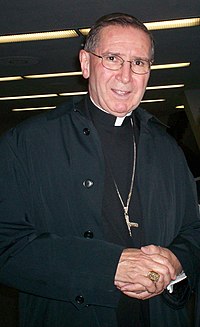
Roger Cardinal Mahony is full of it right up to his chin,
I like the Latin Mass because it is reverent, quiet,
peaceful and not open to all kinds of happy-clappy crap,
I am so sick and tired of the constant effort to entertain,
involve, show off, and the constant stimulation of the
novis ordo, our Priest commented in a sermon lately that we need quiet time to listen for the Lord, immediately after the sermon itwas nonstop prayer or music the rest of the Mass, immediately afterwords the visiting started as the mas rush for the doors started, peace and quiet my @#$%^&**, oh you know.
By the way Cardinal, I was born in 1959, so it's not that I cannot accept change, I want it and I need it

The Egyptian


Anyway from;

The Creative Minority Report


First the bad news. I hope that even the non-traditionalist, non liturgically minded readers of CMR will agree that the following quote from Roger Cardinal Mahony of Loas Angeles reflects a 3rd grade understanding of liturgy and is just plain offensive. Fr. John Zuhlsdorf reports that the Cardinal said this at the Exhibit Hall at the Religious Education Congres.
Ann Scolari: What are your thoughts on the Trindentine mass?

CardinalMahony: Ann: The Tridentine Mass was meant for those who could not make the transition from Latin to English [or other languages] after the Council. But there is no participation by the people, and I don’t believe that instills the spirit of Christ among us.
There are many things I could say about the previous quote. I could throw quotes from dozens of Popes at you, I can quote Summorum Pontificum, and I can quote Councils all in the effort to pursuade you how utterly un-Catholic is the viewpoint of the Cardinal. But I trust, however, that all Catholics of good will and a fourth grade reading level are already pursuaded.

The title of this post is Good News Bad News, so you might naturally be wondering, "what is the good news?"

Well February 27th was the Seventy third birthday of the Cardinal. So the good news is that it is a mere 728 days until the Cardinal must submit his resignation. Tick, Tock.

Tuesday, February 10, 2009

Blunt, and to the point

Wish he could preach around here so many need a slap in the face

From; Overheard in the Sacristy

By Fr LW Gonzales On February 8th, 2009

There are times when a comment to a post speaks for many. Here follows Vatican 2 Catholic’s comment to my post of His Holiness bearing the title: Viva Il papa! Viva!

This article is going to be very blunt right off the bat. In regards to the recent numerous attacks on Pope Benedict and the lifting of the excommunications of the SSPX the critical priests, bishops, cardinals who are pledged in obedience to the pope quite frankly need to shut up.

What a bunch of self righteous tradition hating intolerant bigots. Talk about showing one’s true colors. Way to be true to the Gospels and imitators of Christ by reaching out and welcoming back a million plus Catholic souls who have been isolated from the Church for over twenty years. Great pastoral work there boys! To be frank you critics of the Pope are as just as light headed as the rest of these media junkies who couldn’t get a Catholic thing right if the Pope himself educated them. If you think one
stupid bishop’s comments in an interview done last fall changes the stance of the Church’s teaching and the efforts that Pope Benedict has made through his entire life to work against anti-Semitism then your just as blind as the rest of them.

We’re really getting sick and tired of half ass Catholics who are more so in name than in deed attacking the Church and the person God Himself has appointed as the Vicar of Christ (in case you forgot your theology in your bureaucratic politics).

Hardly one of you has done a blasted thing to condemn the sex scandals and hold your fellow bishops or priests accountable.

Hardly any of you has followed the documents of the Council in regards to the liturgy and ecumenism. As far as many of us obedient and orthodox ‘novus ordo’ Catholics are concerned you’re just as disobedient and on the verge of schism as the SSPX.

We have traveled to at least 15 western countries world wide since the release of Redemptionis Sacramentum and have hardly seen any implementation of the document who your so called ‘beloved John Paul the Great’ mandated to be implemented immediately.

Half of you have been a bunch of cowards in following the teachings of the Church in regards to abortion, politicians and the reception of the Body of Christ in the Eucharist.

We haven’t seen any unified public condemnation for the widespread dissent in your seminaries and convents. But in some of your seminaries the frequent occuring of online use of pornographic materials and child porn in some cases doesn’t seem to be a concern to you.

The disregard for adherence to the teachings of Humanae Vitae and holding your priests accountable are completely out of line with your ‘vocation descriptions’.

Your lack of excommunications or corrections for Catholics and Catholic Universities who out rightly defy or deny almost every sexual teaching that the Church holds including the open declaration of many of your priests to support same sex unions and participation in gay events is frankly disgusting.

Many of you continue to do nothing in correcting and dealing with the many priests, nuns, and laity who openly defy and disobey the teachings of celibacy and woman’s ordinations.

The European bishops have done a great job at keeping up the Churches as museums but in Church attendance they have failed miserably which shows a lack of doing what a bishop is suppose to do, teach the faith.

The lack of excommunications for ‘Catholics who have endorsed or enabled the availability of same sex unions.

The Canadian Bishops have yet to rebuke the 200 plus religious orders who in 2007 generated a report full of dissent in teaching, discipline, sexuality, celibacy, homosexuality, divorce, and female ordination.

The Canadian Conference of Bishops still refuse to allow the Vatican to investigate whether the Winnipeg Statement contains schismatic claims.

And you bishops world wide continue to question the authority of the pope and the huge dilemma he has to fix because of your failings. Look to yourselves before you criticize and condemn others.

Wake up priests and bishops and do your jobs. The pope is doing an excellent job of getting the Catholic Church back on its feet and unifying all Christians back into the fold. And you stand there like a bunch of hypocrites criticizing your leader. Maybe if you started following His example in teaching, example especially in regards to Ecumenism and Liturgy you would see a change in the world in which you have allowed to become so corrupt with sin. And if you had been as obedient and tolerable as you
claim to be then you would have never allowed this situation to get to where its at. Stop pointing fingers at the Pope and start pointing them to God in prayer. Your lack of charity with both the Pope and the millions of Catholics who adhere to the authentic teachings of the Catholic Church is no
longer tolerable. Either wake up and deal with the crisis of faith that you have allowed to occur for the past 40 years or as John Paul told the liberal regimists in South America “Silencio” .

Just look at the simple comments from the Pope on the Media recently released asking us to use the media to proclaim the Gospel and instead you use it to create friction, division and attack your leader. This goes just as well for the Bishop Williams fellow as well. Great example from our leaders and teachers of the faith!

To be a member of the Catholic Church means you adhere to the teachings and the Magisterium, Not attack it! If you’re not with the Church then you are against the Church. It’s that simple. Not our words Jesus’. These internal attacks on the orthodoxy of the faith and the papacy need to end now! This
nonsense has been going on for 40 plus years and quite frankly its sinful. The Catholic Church is not an organization running a Public Relations campaign. The Catholic Faith is not an opinion it is a way of life. The faith is not a Catholic buffet either you accept it in fullness or get out. Why do you distract those who have chosen the Church as their way of life with your spiritual garbage. Why are you in the Church if you are not here to build it up. Why are you still here if you hate orthodoxy and the Church’s teachings.

The Catholic Church is the One True Church of Jesus Christ in which is concerned only with the salvation of all mankind. If that is not your mission within the Church to cooperate with God’s mission and save souls including the million plus members of the SSPX then as Vatican II says ‘You are neither of use to yourself or to the Church’. If you attack the Papacy you are attacking the Church. If you are attacking the Church you are attacking Jesus Himself. It’s really time for the Church’s members to stop attacking the Church and start building it up. Your are the body of Christ. You are the salt of the earth. You are commanded to save souls. You are told to preach the gospel. “I give you a new commandment love one another as I have loved you”