Showing posts with label Catholic Worship. Show all posts

Monday, April 12, 2010

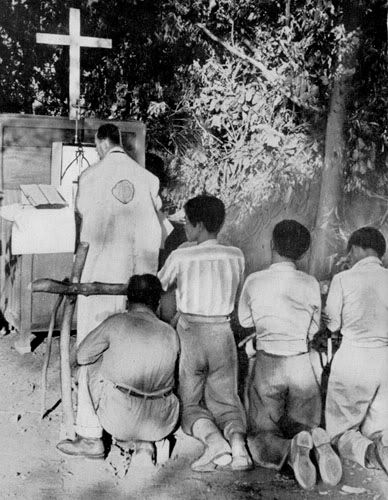
Real Priests, we have it so easy today

How sad the poor people in attendance could not participate, they were so deprived and didn't even know it. Bet they appreciated it more.

The Egyptian
From the Crescat.

mass in Bataan...

Saturday, February 27, 2010

Good Instruction on Mass Participation

another one from 10 reasons

Notice there is nothing about holding hands or orans position, just prayerful dignity, no Happy Clappy crap.

The Egyptian


Real liturgical movement

The other day I posted about the University of Dayton's "euphemization" of liturgical dance by renaming it movement. Yet as the latest issue of the Adoremus Bulletin shows us, the Mass already contains plenty of required and recommended movements, many of which go unobserved. We might spend time learning them instead of going off in dubious directions. Here's a list of these gestures and postures for just the entrance rites:
Make the sign of the cross with holy water (a sign of baptism) upon entering the church.

Genuflect toward the tabernacle containing the Blessed Sacrament and the Altar of Sacrifice before entering the pew. (If there is no tabernacle in the sanctuary, or it is not visible, bow deeply, from the waist, toward the altar before entering the pew.)

Kneel upon entering the pew for private prayer before Mass begins.

Stand for the entrance procession.

Bow when the crucifix, a visible symbol of Christ’s sacrifice, passes you in the procession. (If there is a bishop, bow when he passes, as a sign of recognition that he represents the authority of the Church and of Christ as shepherd of the flock.)

Remain standing for the entrance rites. Make the sign of the cross with the priest at the beginning of Mass.

Strike your breast at the “mea culpa(s)” (“through my fault”) in the Confiteor.

Bow and make the sign of the cross when the priest says “May Almighty God have mercy…”

Bow your head when you say “Lord, have mercy” during the Kyrie.

If there is a Rite of Sprinkling (Asperges), make the sign of the cross when the priest sprinkles water from the aspergillum in your direction.

Throughout the Mass, bow your head at every mention of the name of Jesus and every time the Doxology [“Glory be”] is spoken or sung. Also when asking the Lord to receive our prayer.

Gloria: bow your head at the name of Jesus. (“Lord Jesus Christ, only begotten Son…”, “You alone are the Most High, Jesus Christ…” )

Sunday, January 24, 2010

Leonine Prayers explained

great new blog, always wondered how some prayers started, well the Leonine Prayers are explained here
the Egyptian

from: Let The Welkin Ring

St Michael Archangel

On October 13th, 1884, Pope Leo XIII had a remarkable vision. When the aged Pontiff had finished celebrating Mass in his private Vatican chapel, attended by a few Cardinals and members of the Vatican staff, he suddenly stopped at the foot of the altar. He stood there for about ten minutes, as if in a trance, his face ashen white. Then, going immediately from his chapel to his office, he composed the prayer to St Michael, with instructions it be said after all Low Masses everywhere. When asked what had happened, he explained that, as he was about to leave the foot of the altar, he suddenly heard voices – two voices, one kind and gentle, the other guttural and harsh. They seemed to come from near the tabernacle. As he listened, he heard the following conversation:

The guttural voice, the voice of Satan in his pride, boasted to Our Lord:

“I can destroy your Church.”

The gentle voice of the Lord:

“You can? Then go ahead and do so.”

Satan:

To do so, I need more time and more power.”

Our Lord:

“How much time? How much power?”

Satan:

75 to 100 years, and a greater power over those who will give themselves over to my service.”

Our Lord:

“You have the time, you will have the power. Do with them what you will.”

That was Pope Leo's vision in 1884. Satan said that he needed between 75 and 100 years. 75 years onto 1884 brings us to 1959 (incidentally, the year of my ordination!) and in the January of that year Pope John XXIII called the Second Vatican Council. Just about the first thing to come from the deliberations of the Council Fathers, which began in earnest in 1963, was the abandonment in 1964 of the Leonine Prayers, the prayers at the end of Mass which called St Michael to the aid of the Church on earth.

In the years from 1959 to 1984, judge for yourselves whether Satan has kept his promise to destroy the Lord’s Church. Of course, the Lord’s Church can never be destroyed altogether. But, ask yourself, if you are old enough to remember, were parish churches fuller in 1984 (and since) than in 1959? What happened to parish societies, like the SVP and the Legion of Mary, in that time? Has the Church been more united in worship? Are we more united in doctrine than ever before, or is everyman his own Pope now?

One particular loss of belief which we have suffered is the belief in Satan and his awful army of devils who seek to destroy our spiritual life with God. I love to say the Leonine Prayers whenever I can, and I hope and pray that some day they will be re-instated at the end of every Mass which is celebrated.

Saturday, January 16, 2010

Lets Get With The Program, Shall We Folks

What does the Holy Father have to do, whack Bishops with his Crosier. By the way the "east" referred to here is liturgical east or facing the lord with the congregation, verses west which is facing the people or Verses Populum, this is not an expensive thing or difficult, it serves as a reminder to the priest that he is not the center of attention here, the Lord is. I know for some priests that may come as a shock.

Pope wants crucifix at the center of ALL westward-facing altars during Mass, says papal MC. So why do our bishops ignore him?

The Pope incenses an altar with a crucifix    Photo: Getty

The Pope incenses an altar that displays a crucifix Photo: Getty

Monsignor Guido Marini, Benedict XVI’s master of ceremonies, this week strongly underlined the Pope’s recommendation that when Mass is celebrated facing westwards, the priest should place a crucifix at the centre of the altar. This was to make clear that the celebrant was not “facing the people”, but facing Christ.

The Holy Father could hardly have made himself clearer on this point. So why do the Bishops of England and Wales allow the vast majority of their priests to ignore his wishes? Why do the bishops themselves routinely ignore the recommendation?

Perhaps someone will ask the bishops when they make their ad limina visit to Rome at the end of this month. One hopes that Archbishop Vincent Nichols, president of the Bishops’ Conference, will be able to reply that the bishops have drawn up plans to introduce this reform universally – and also to make it easier for the faithful to receive communion kneeling and on the tongue, which is the preference of the Pope. (At the moment, too many parish priests treat anyone wishing to receive the Sacrament in this way as an oddball, rather than a Catholic following the example of the Holy Father.)

Below are some extracts from Mgr Marini’s address to the Year for Priests Clergy Conference in Rome, organised by the Australian Confraternity of Catholic Clergy. Hat-tip to that incomparable resource, The New Liturgical Movement website.

Here is Mgr Marini on the question of orientation. Note that he, like the Pope, supports eastward-facing celebration where it is appropriate:

Without recourse to a detailed historical analysis of the development of Christian art, we would like to reaffirm that prayer facing east, more specifically, facing the Lord, is a characteristic expression of the authentic spirit of the liturgy. It is according to this sense that we are invited to turn our hearts to the Lord during the celebration of the Eucharistic Liturgy, as the introductory dialogue to the Preface well reminds us. Sursum corda “Lift up your hearts,” exhorts the priest, and all respond: Habemus ad Dominum “We lift them up unto the Lord.” Now if such an orientation must always be adopted interiorly by the entire Christian community when it gathers in prayer, it should be possible to find this orientation expressed externally by means of signs as well. The external sign, moreover, cannot but be true, in such a way that through it the correct spiritual attitude is rendered visible.

Hence the reason for the proposal made by the then Cardinal Ratzinger, and presently reaffirmed during the course of his pontificate, to place the Crucifix on the centre of the altar, in order that all, during the celebration of the liturgy, may concretely face and look upon Lord, in such a way as to orient also their prayer and hearts. Let us listen to the words of his Holiness, Benedict XVI, directly, who in the preface to the first book of his Complete Works, dedicated to the liturgy, writes the following: “The idea that the priest and people should stare at one another during prayer was born only in modern Christianity, and is completely alien to the ancient Church. The priest and people most certainly do not pray one to the other, but to the one Lord. Therefore, they stare in the same direction during prayer: either towards the east as a cosmic symbol of the Lord who comes, or, where this is not possible, towards the image of Christ in the apse, towards a crucifix, or simply towards the heavens, as our Lord Himself did in his priestly prayer the night before His Passion (John 17.1) In the meantime the proposal made by me at the end of the chapter treating this question in my work ‘The Spirit of the Liturgy’ is fortunately becoming more and more common: rather than proceeding with further transformations, simply to place the crucifix at the center of the altar, which both priest and the faithful can face and be lead in this way towards the Lord, whom everyone addresses in prayer together.” (trans. from the Italian.)

Let it not be said, moreover, that the image of our Lord crucified obstructs the sight of the faithful from that of the priest, for they are not to look to the celebrant at that point in the liturgy! They are to turn their gaze towards the Lord! In like manner, the presider of the celebration should also be able to turn towards the Lord. The crucifix does not obstruct our view; rather it expands our horizon to see the world of God; the crucifix brings us to meditate on the mystery; it introduces us to the heavens from where the only light capable of making sense of life on this earth comes. Our sight, in truth, would be blinded and obstructed were our eyes to remain fixed on those things that display only man and his works.

In this way one can come to understand why it is still possible today to celebrate the holy Mass upon the old altars, when the particular architectural and artistic features of our churches would advise it. Also in this, the Holy Father gives us an example when he celebrates the holy Eucharist at the ancient altar of the Sistine Chapel on the feast of the Baptism of our Lord.

In our time, the expression “celebrating facing the people” has entered our common vocabulary. If one’s intention in using this expression is to describe the location of the priest, who, due to the fact that today he often finds himself facing the congregation because of the placement of the altar, in this case such an expression is acceptable. Yet such an expression would be categorically unacceptable the moment it comes to express a theological proposition. Theologically speaking, the holy Mass, as a matter of fact, is always addressed to God through Christ our Lord, and it would be a grievous error to imagine that the principal orientation of the sacrificial action is the community. Such an orientation, therefore, of turning towards the Lord must animate the interior participation of each individual during the liturgy. It is likewise equally important that this orientation be quite visible in the liturgical sign as well.

And on the question of kneeling to receive Communion on the tongue:

Here is the reason why everything in the liturgical act, through the nobility, the beauty, and the harmony of the exterior sign, must be conducive to adoration, to union with God: this includes the music, the singing, the periods of silence, the manner of proclaiming the Word of the Lord, and the manner of praying, the gestures employed, the liturgical vestments and the sacred vessels and other furnishings, as well as the sacred edifice in its entirety. It is under this perspective that the decision of his Holiness, Benedict XVI, is to be taken into consideration, who, starting from the feast of Corpus Christi last year, has begun to distribute holy Communion to the kneeling faithful directly on the tongue. By the example of this action, the Holy Father invites us to render visible the proper attitude of adoration before the greatness of the mystery of the Eucharistic presence of our Lord. An attitude of adoration which must be fostered all the more when approaching the most holy Eucharist in the other forms permitted today.

So let us get this straight. The Pope is asking priests to place a crucifix on the altar and inviting communicants to receive in the traditional manner. Yet these developments, arising out of the Pontiff’s profound reflections on divine worship, receive no support from the Bishops of England and Wales.

Archbishop Vincent Nichols has paid frequent tribute to the vision of Benedict XVI. The liturgical reality in most parishes in this country has not even begun to reflect that vision. The Archbishop is a strong and resourceful leader; when is he going to turn his attention to this discrepancy?

Monday, January 4, 2010

Oh so TRUE, beige brick boxes don't cut it

from Fr Longnecker

Mother of God


Charleston Cathedral all dressed up for the Solemnity of the Mother of God on Friday. It was really nice to be able to sit in the pew and worship quietly for once. The beauty of the liturgy and the high gothic style of the cathedral reminded me how important beauty is for worship. The anonymous architect of the ancient abbey of Glastonbury said, "I want to create a building so beautiful that even the hardest heart will be moved to prayer."

Pancake and circus tent churches just don't cut it. This is because they have been designed by followers of the 'form follows function' school of architecture. Even if this is a proper dictum for architects, it overlooks the fact that one of the functions of a Catholic church is to inspire and uplift the heart, and the only way to do that is through beauty. Why does the heart lift in a church with high ceilings, lofty stained glass and pointed arches? Because as they eye is lifted up the heart is lifted up. The eye, the mind and the heart ascend in an act of worship simply by entering a lofty building. The beauty and richness of marble and stone and glass take the worshiper into a new dimension--a less mundane dimension.

Of course the Mass is the Mass, and the Christ child who was born in a stable is still present in the humblest of settings. But that Christ child of Bethlehem is also the King of Kings and Lord of Lords. We should try our hardest and make the sacrifices necessary to build a temple fit for the one before whom the kings of the East prostrated themselves.

Wednesday, September 2, 2009

Total Faith In GOD

forgot where I got this but the bravery and FAITH of the priests in WWII is beyond compare, really people are so soft today

The Egyptian

Once there was a time...

I told this story at dinner the other night. The family liked it, and Puff told me I should write it out on the blog. Like most of my best stories, it isn't my story at all, but my father's, and like many of his best stories, it's from the war.

Dad was at or near the front lines in Italy one day when an officer came down the line. "Any Catholics here," he began. "There's a priest about to say Mass in the next field." Dad took his helmet and rifle and headed over to the next field, as did several other Catholics.

He was appalled when he arrived. The field was wide open, easily visible from the Germans, and exposed to any kind of enemy fire. The men immediately looked for a hill, a shell hole, a rock, a furrow- anything that might give them any sort of cover. Meanwhile, in the middle of the field stood the priest, carefully setting up his Mass kit on a big rock, taking his time and doing it properly, appearing as if he had no concern in the world other than this, and going about it as if he were in a parish back home, and there was no war to trouble anyone or anything.

If there was ever a time for a Tridentine speed Mass, this could have been it. But, to Dad's horror, (and he knew, because he used to be an altar boy at a Cathedral) the priest said the Mass slowly and carefully, doing every movement as prescribed, omitting no prayer, while gunfire raged around them.

At last the priest turned, holding the consecrated host. "Come to Communion!" he shouted out to the men hiding in the field. "I grant you all full absolution. Come!"

Dad's reaction was: "He's got to be kidding." But then he saw it: the soldiers making their way forward to receive communion. Granted, they approached the priest at a dead run, and left at a dead run as soon as it was received. But still they came. Dad, emboldened by the other men, came forward himself, received, thanked God, and raced away.

He stayed in his furrow watching as the priest put away his Mass kit as properly as he set it out, and, when finished and having said his final prayers, the priest snapped his case shut and walked away.

That's the story. Not the best punch line, but the family liked it. I like it for it reminds of a good man I once knew and shall never see again in the flesh. It reminds me that there were other good men like him, once upon a time. Men who believed there were things to stand for, things to fight for, things that were worth risking your life for. And on that list of things worth risking your life over was Mass, and the chance for Communion.

Saturday, August 15, 2009

from the New York Times, letter to the editors

first paragraph is a good comparison, and last two help explain, forgot how I received this but to good to delete.

Enjoy
The Egyptian

As far as the Church is concerned, I think that there was a period of collective drunkenness, starting with the excesses of good wine with V II itself and continuing with the ocean of vodka of “the spirit of V II”. The top (the Vatican) has sobered down relatively fast and in 1978 sobriety was firmly in charge within the conclave, but there was no courage to eradicate bad habits among the generation of guitar-strumming alcoholics who in the meantime had spread all over Catholicism, starting from the bishops.
What I think is happening is that from above (the Vatican) Chianti Classico is slowly being introduced again, but that it will never establish itself as a habit among those who have spent a life amidst bloody marys and alcopops.
Whilst I think that a bigger effort should be done to kick out some of the worst offenders (the South of England being a point in case), I do understand that there is no great desire at the top to start fights when, as a famous drug addict once said, “time is on our side”.
——-
What the NYT readers might be helped to understand by this article is that as JP II was an improvement on Paul VI and BXVI is a big improvement over JP II, Benedict’s successor will be an improvement on him and will feel free to continue his work of sobering down the trendy masses with greater energy, and his successor more than him. This is what the future will bring and they’ll better get accustomed to the idea now.
————————————
I see far brighter days ahead, and the Holy Ghost silently and slowly, but steadily working on the necessary repairs of Peter’s Barque: vocations clearly come from the conservative side and the hippies are utterly despised among the younger faithful, whilst the Anglicans disintegrate worldwide and show once again the destiny of every man made “church”.
In an age of “freedoms”, more and more people discover that what they want is guidance; the Catholic church has never been so well regarded even in the protestant world and nowadays a Protestant President of the United States dares to be present at a Pope’s funeral, his brother a Catholic convert! In time, the Catholic Church will be seen by more and more people as the only alternative, whilst many Protestants drown in an ocean of political correctness making them less and less recognisable as Christians.
If you ask me, the future belongs to conservative Protestants and Catholics. All the others will end like the dinosaurs.
—-

Saturday, August 8, 2009

beautiful evening


Posting some poor pictures from my cell phone at the Fatima Evening at the Spiritual Center of Maria Stein last night. First mass then the Rosary, then a procession with the Virgin in the lead through the woods just the glow of the candles was inspiring, especially on the winding path through the woods. Also got to meet fellow blogger Fr. Fox ( Bonfire of the Vanities ), nice to meet you Father and don't worry the Latin will come, we up here are waiting.

Tuesday, August 4, 2009

great commentary by Fr Martin Fox

From Bonfire of the Vanities

Monday, August 03, 2009
St. Catherine of Siena, Great Falls Virginia
(I've been remiss in telling you about the sacred places I've visited on my vacation; I will, I hope, tell you about my visit to the shrine of St. John Newmann in Philadelphia before long; but here follows my experience of Sunday Mass in Northern Virginia.)

On the Lord's Day, I had the joy of concelebrating the Mass with Father Alexander Drummond, pastor of St. Catherine Parish in Great Falls, Virginia. I had heard good things, and also a friend of mine, who is not Catholic, asked about attending Mass with me, and then we'd visit afterward; I wanted him to have a good experience of the Holy Sacrifice.

Everything was praiseworthy, and I told Father Drummond I was envious of many of the things he had accomplished. His servers were very well trained and performed beautifully. He had so many for the first Sunday in August--he said, "they flock to this Mass." He had one very young fellow, Thomas, who was learning the ropes; apparently, Father has new fellows just show up, put on a cassock and surplice, and be guided by the older, more experienced servers--although he also has classes.

This suburban parish of 4,000 families has four Masses a weekend; I took part in the 10 am Mass, which was all in Latin, except for the readings, prayers of the faithful, and of course the homily. Everything else was in Latin, from the opening Sign of the Cross to the final "Ite, Missa Est." We did pray the prayer to St. Michael in English, but the closing hymn was the Salve Regina.

Father sang a few of the prayers of the Mass, but he was using the same, Missa in Cantu book I have, that provides all the prayers of the Mass, in Latin, set to chant; I use it at the 8 am Mass every first Wednesday of the Month at St. Mary, and his copy was well-thumbed; so I'm assuming he often chants the prayers. Those he chanted, he did so impeccably.

This Mass featured the assigned music for the opening, offertory and communion: it is very little known or understood that when we use hymns at this point--as the vast majority of Catholic parishes do--we are consistently avoiding what the Second Vatican Council, and the norms for the Mass, actually call for, which is Scripture-based texts set to chant. They can be sung in the original Latin, to Gregorian tones; or they can be chanted in English; at Masses with no music, you will hear the antiphon recited from time to time--this is the bare minimum.

At this Mass, they were sung by a cantor in Latin, in Gregorian chant--and that was done beautifully. No doubt, some would react negatively: they couldn't themselves sing along (and in fact almost everyone listened); and they wouldn't immediately recognize the words. But a program was handed out that provided both the Latin text and an English translation. Of course, listening is participation; and it would be a terrible mistake to reduce music merely to its words; music, rather, marries a meaningful text to a well-chosen set of notes, something I lack the talent to do, but others possess: and the combination is the true, good and beautiful all in one. So the fact that folks did not sing it does not mean they weren't participating; sometimes something is so beautiful, you simply listen.

Because, in fact, people did sing the other prayers of the Mass, in Latin, rather well: the Gloria and the Credo in particular. There is something deeply meaningful to me about praying the Creed in it's original words: the Councils of Nicea and Constantinople, from which we derive this Creed, published this infallible statement of faith in Latin and Greek, and we recite it in the very same words (with the addition of the filioque of course, but let us not tarry on that point).

Another feature of the Mass was the use of ad orientem--that is, while at the altar for the liturgy of the Eucharist and the communion rite, the celebrant faced the same way as the people, and thus all faced the Lord together; some will refer to this as the priest "with his back to the people." Of course, I have no idea what the folks of the parish thought about it, and no doubt those who dislike it attend the other Masses where this is not done. But those present seemed cheerful and spiritually nourished as they left Mass. There were a lot of children, including young children, at the Mass; while there was a hermetically sealed "cry room," there were plenty of young ones outside of it, and I did not notice any significant increase in vocal meltdowns at this allegedly less-engaging Mass.

At this point, you may be confused--you may say, "oh, you mean you concelebrated the older form of the Mass, from before the Council." No, this is the Mass as reformed after the Council, according to all the proper norms and rubrics, as provided for the very same sacramentary, or book of Mass prayers, used at every Roman-Rite Catholic parish in the world.

"But wait, Father, how can that be? You said it was in Latin, and the priest was facing the same way as the people--wasn't all that done away with by the Council?"

While that is what a lot of people believe, and were told, the answer is no; on the contrary, many are shocked to discover that, far from abolishing these things, the Council presupposed both that Latin would continue to be used, to some degree, and the Council said not a single word about the priest moving to the other side of the altar--i.e., the Council never called for that latter change. And even the post-Counciliar implementation of the new Mass did not mandate the priest stand behind the altar and face the people. Like the use of the vernacular, it was allowed as an option, an option almost universally implemented, to the point some now insist it is mandatory. But not so.

My friend, over breakfast, said he found it beautiful and spiritually refreshing: "it was what I needed today." But he asked what many ask: "why is Latin important?"

I gave him the following reasons:

1) It connects us, in an experiential way, to our formative roots. The liturgy is not a re-creation of the Last Supper; but an experience, in mystery (i.e., via sacramental reality), of all the actions of Christ that save us: his life, death, resurrection and ascension into heaven. The Mass is all this rolled into one, and more. That's why we don't do it in Aramaic or Greek, but we do it in Latin, because the Roman form of the sacred liturgy was formed in Latin--that is the Mass's original language, and remains so this this very minute.

2) Keeping Latin just a little alive in our experience and consciousness opens us up to a vast treasury of our patrimony which orginated in Latin. Of course, the written word can be translated, but poetry and music, not so well. When was the last time someone at a wedding or funeral asked for the Ave Maria to be sung--but in English? Why do they always want it sung in Latin? Because it's beautiful; and translating it undoes the beauty of the singular expression. This is why so much of our music hasn't been translated from the Latin; it has simply been left behind.

3) There is a value to praying a kind of sacred language, based on something observable in the human mind. Alongside all the advantages of having the Mass and other sacramental rituals in our own language, there is a downside--of approaching the liturgy, and the mystery it makes present, primarily with our intellectual function. When we hear words we understand, our intellect is engaged, and we "digest" the words and the ideas they convey. This is good of course; but the danger is in thinking the mysteries made present in the Mass should be approached principally in this fashion. In fact, we do well to approach these mysteries on various levels, the level of intellectual understanding being only one level.

In short, the danger is to flatten and make mundane the mystery. Someone says, "I don't like praying words I don't understand." But who can say s/he understands what it means to call God "holy"? We are kidding ourselves if we understand the meaning of calling him "holy" better than we understand calling him "sanctus."

My point being that using Latin--even with a translation handy--provides a kind of circuit-breaker that enables us to separate the experience of mystery from the apprehension of the mystery with our intellects; so that we don't just make the distinction in an abstract way, but we experience it. Learning, after all, isn't just a matter of being told something, or getting it abstractly, but by doing: you don't learn to drive merely by having the concepts and methods explained to you; you have to get behind the wheel.

It truly saddens me that there is not more openness to this. I wish more people could experience the liturgy as I did on Sunday, as I have many times before elsewhere. The very fact that a more familiar path is closed--the path of hearing and responding in ones own language--is closed, opens up new avenues unconsidered; just as you find if, while awake, you silence yourself and your surroundings, and close your eyes, you will, after a few minutes, find you are hearing things you seemingly didn't hear a few minutes before; or when you look up into the night sky, with all the artificial light turned off: you see things you never knew were there. I am convinced that many people would have similarly surprising discoveries in the liturgy where it is celebrated to a significant degree in Latin, and with more silence and dignity, less constant pressure for everyone to be saying something and moving about; but the resistance is constant, and the steps are small.

Thursday, June 25, 2009

SSPX Ordinations in Winona Minn

Where else would you see such devotion in young people, puts to shame the critics that claim that the Latin Mass is only for old people that can't or won't change, BULL CRAP, bet you couldn't get these kind of answers from the average youth at a modern parish

Thursday, June 18, 2009

God Lovers and People Lovers at Mass

"The final result of all this is that we have been left with the only remaining remnant: the love of ourselves. Thus, in too much of Catholic worship what was once the glorious worship of Almighty God has become a jumble of comfort hymns and self-help therapy."

from the National Catholic Register

This really gets to the point of the first part of my rant below, the horizontal comes after and is subordinate to the vertical. All credit to Fr. Longnecker. see his blogs

http://www.dwightlongenecker.com/

and my favorite

http://gkupsidedown.blogspot.com/

the Egyptian

BY Father Dwight Longenecker

When Jesus was asked which of the commandments was most important, he replied that we should love God and love our neighbor. He added that on these two commandments hang all the Law and the prophets. He might have added that on these two things hang everything that matters to everyone everywhere.

Most importantly, it is the love of God and the love of our neighbor that matters if we take our Christian faith seriously. All the rules and regulations and rubrics, all the debates and doctrines and dogmas are meaningless if we do not have the love of God and the love of our neighbor.

It is a quirk of human nature, however, that most of us fall into one of two categories. We are either “God lovers” or “people lovers.” If you like, all of us have a natural preference or a built-in instinct to focus on one or the other.

Those who are God lovers are more interested in the vertical than the horizontal. They focus on the other world rather than this world. They concentrate on liturgy, spirituality, prayer, adoration, consecrated life, vocation, religion and worship. They see the Church as the fellowship of saints and angels gathered around the throne of God. God lovers tend to be more cerebral, traditional, conservative and concerned with right worship, right behavior and right belief.

Those who are people lovers are more interested in the horizontal. They focus on this world more than the next world. They concentrate on peace and justice and ministering to others. They see the Church as the people of God here on earth, making their pilgrimage to heaven. The people lovers tend to be more relational, intuitive, progressive and innovative. The sit lightly regarding rules and dogmas and are more concerned with expressing God’s love through compassionate relationships with their brothers and sisters.

The God lovers see the Mass as a solemn sacrifice that lifts mankind to the very threshold of heaven. They want fine liturgy and esoteric, magnificent and otherworldly worship. For the God lovers, worship transports us from this vale of tears to the worship of the cosmic spheres. For them, the Mass is the great sacrifice that applies the eternal act of redemption to souls in need of salvation.

The people lovers see the Mass as the fellowship meal of the people of God. The worship is warm and comforting. It is designed to make everyone experience the love of God here and now. The Church is a place of welcome for all. Worship is a healing, inspiring action designed to make everyone feel forgiven and feel good about themselves and each other. The Church is in this world and is of this world and needs to adapt to this world so that more and more people can be helped.

As you read this, you are probably already instinctively choosing which of these two models you like best. You will believe that yours is the best, and that, at best, the other one is faulty, and, at worst, it is heretical and damaging to the Church and should be stopped.

But we need both, don’t we? We’re called to love God and love our neighbor. There is certainly a divide within Catholicism, and if it can be analyzed in this way, why does such a divide exist?

The divide between the God lovers and the people lovers exists not because one is right and the other is wrong. The divide exists because we have not prioritized properly.

The lovers of people may not like to hear this, but the love of God is the first priority. Love of neighbor comes after the love of God and is dependent on the love of God. We cannot love our neighbor if we do not love God first. Why? Because we have no motive, no power and no grace to love our neighbor if we have not loved God first.

Therefore, the love of God is the Catholic priority. Loving our neighbor is mandatory and cannot be overlooked, but it comes after the love of God. If this is true, then we must ask ourselves where we properly love God and where we properly love our neighbor. The answer is that we love God primarily within the life of prayer and worship: within and through the liturgy.

If we love God in church, then we love our neighbor outside of church. Most of the problems with modernist liturgy and worship are that progressive Catholics have brought into the Church what rightly belongs outside of the Church. In other words, the fellowship, the peace and justice, the social activism, the missionary enterprise, the education and health care and family concern — all of this is the proper activity of the people of God outside of the liturgy, and we have brought it into the liturgy.

As a result, the liturgy has become all about loving people instead of loving God. Why is this? Because too many Catholics have actually replaced the love of God with the love of people. Clever theologians thought that the supernatural, otherworldly aspect of worship seemed too much of a stretch for ordinary, modern, scientific people, and they made the liturgy folksy and people-centered in order to adapt the faith for modern man.

The result has been a disaster. Catholics, therefore, love people, but many have lost the language for loving God; and the greatest sadness is that once you no longer love God, it is not very long before you are no longer able to love people either, for what do you find to love in people if you have not loved God first? For the only thing I truly love in my neighbor is the image of God in him, and the only way I can discern this is by first learning to love God.

The final result of all this is that we have been left with the only remaining remnant: the love of ourselves. Thus, in too much of Catholic worship what was once the glorious worship of Almighty God has become a jumble of comfort hymns and self-help therapy.

The only remedy is to return to Christ’s priorities: to learn once more how to put the love of God first in our lives so that we may eventually learn again how to love our neighbor.

Father Dwight Longenecker is chaplain to St. Joseph’s Catholic School in Greenville, South Carolina.

Tuesday, June 16, 2009

What we are Missing

After the last post with the pita bread in a barbecue tongs benediction farce I thought this was appropriate, swiped with love and admiration, from the Cavemen, crap you guys are great!!!

Vatican II "Springtime" Update: True Mass or New Mass?

I know that this post will truly piss off many Conservative "John Paul II-We love you" type Catholics. But I figured, what the heck? Why not start the week off right!

TRUE MASS


NEW MASS


Saturday, May 30, 2009

churches are scandalously liberalized in America.

Why does it take a former communist mouth piece like Pravda to point this out, PLEASE read the last paragraph, and add the liberal whiny weak kneed bishops and priests who don't want to rock the boat to the list, the WINNING SIDE my ass. Bring back Latin, and reverent worship, enough Happy-Clappy crap already.

The Egyptian

Friday, May 29, 2009

Pravda Mocks US Descent Into Marxism at Breakneck Speed

If only we had a fair and balanced media outlet like Pravda.
The last time we heard from this former Soviet news agency they were commenting on how there was major bias by the US media in this past year's national elections.
Now they are warning America about creeping Marxism.
You wouldn't dare see a US journalist do this.
They'd risk getting dragged from the airport tarmac if they did.
The reporters at Pravda are mocking America's decent into Marxism at breakneck speed:

It must be said, that like the breaking of a great dam, the American decent into Marxism is happening with breath taking speed, against the back drop of a passive, hapless sheeple, excuse me dear reader, I meant people.

True, the situation has been well prepared on and off for the past century, especially the past twenty years. The initial testing grounds was conducted upon our Holy Russia and a bloody test it was. But we Russians would not just roll over and give up our freedoms and our souls, no matter how much money Wall Street poured into the fists of the Marxists.

Those lessons were taken and used to properly prepare the American populace for the surrender of their freedoms and souls, to the whims of their elites and betters.

First, the population was dumbed down through a politicized and substandard education system based on pop culture, rather then the classics. Americans know more about their favorite TV dramas then the drama in DC that directly affects their lives. They care more for their "right" to choke down a McDonalds burger or a BurgerKing burger than for their constitutional rights. Then they turn around and lecture us about our rights and about our "democracy". Pride blind the foolish.

Then their faith in God was destroyed, until their churches, all tens of thousands of different "branches and denominations" were for the most part little more then Sunday circuses and their televangelists and top protestant mega preachers were more then happy to sell out their souls and flocks to be on the "winning" side of one pseudo Marxist politician or another. Their flocks may complain, but when explained that they would be on the "winning" side, their flocks were ever so quick to reject Christ in hopes for earthly power. Even our Holy Orthodox churches are scandalously liberalized in America.

The final collapse has come with the election of Barack Obama.

Monday, May 11, 2009

Even if there were not a single "traditionalist"

why with close to 40 weekend Masses in this deanery, not one can be a Latin Mass, no one wants to learn or try, or too ashamed to try? If I can be subjected to Guitar and folk masses and hippy dippy all about me church music, and now the attempt to install a hot tub baptismal pond in our church, (are we saying that the protestants were right, that a Catholic pouring baptism is invalid?) surely one traditional, devout, quiet, reverent, prayerful, Latin Mass would not KILL ANYONE, would it. See last paragraph

The Egyptian


From Fr. John Zuhlsdorf His comments in red, as in "say the black do the red"

His Hermeneuticalness picked up something on NLM which deserves some attention. His comments in green

People are starting to pay attention to a preface written by His Eminence Antonio Card. Cañizares for the Spanish translation of Msgr. Nicola Bux excellent book La Riforma di Benedetto XVI: la liturgia tra innovazione e tradizione (Piemme, 2008).

I have the book and it is exceptionally good.

Card. Cañizares made good points in the preface. Here is His Hermeneuticalness’s take with my emphases and comments.

Even if there were not a single "traditionalist" ...

The important book by Fr Nicola Bux, "The Reform of Benedict XVI" has been translated into Spanish and the new edition has a foreword by Cardinal Cañizares Llovera, the Prefect of the Sacred Congregation for Divine Worship. The preface itself is noteworthy and Gregor Kollmorgen has kindly provided a translation at NLM.

In one place, His Eminence speaks of the way in which the term "preconciliar" has been used as an insult "as if an abyss should be created between the "before" and the "after" the Council" and then says:

Today, thanks to the Motu Proprio, this situation is changing notably. And it is doing so in large part because intention of the Pope has not only been to satisfy the followers of Monsignor Lefevbre, nor to confine himself to respond to the just wishes of the faithful who feel attached, for various reasons, to the liturgical heritage represented by the Roman rite, but also, and in a special way, to open the liturgical richness of the Church to all the faithful, thus making possible the discovery of the treasures of the liturgical patrimony of the Church to those who still do not know it. How many times is the attitude of those who disdain them not due to anything other than this ignorance! Therefore, considered from this last aspect, the Motu Proprio makes sense beyond the presence or absence of conflicts: [here it comes…] even if there were not a single "traditionalist" whom to satisfy, this "discovery" would have been enough to justify the provisions of the Pope.

It is so heartening to hear such encouragement from the highest authority on the Liturgy besides the Holy Father himself, that the opening of the liturgical richness of the Church to the faithful by the celebration of the classical Roman Rite is something to be valued in itself for the good of souls, even aside from the provision of this form for those who legitimately ask for it.

Many young clergy will also be encouraged with these words from the Prefect:

How many priests have been called "backward" or "anticonciliar" because of the mere fact of celebrating in a solemn or pious manner or simply for fully obeying the rubrics! It is imperative to get out of this dialectic.

I hope that Fr Bux’s excellent book (which I have read in Italian) will soon be translated into English.

Let’s get at that again,... "even if there were not a single "traditionalist" whom to satisfy, this "discovery" would have been enough to justify the provisions of the Pope".

Many enemies of the Holy Father’s vision will claim that the provision of Summorum Pontificum were only given for those few benighted souls – probably with psychological problems – who cannot make the transition to the wonderful new reformed liturgy celebrated in "spirit of Vatican II" fullness.

Of course they entirely ignore that a greater and greater percentage of people seeking the older forms are people born after the Novus Ordo was implemented.

This merely confirms the fact that liberals always want you to deny the evidence of your senses and simply accept their premises.

On the other hand, some folks have been arguing that the provisions of Pope Benedict go far beyond the mere issue of reconciling the SSPX.

I have been arguing that these provisions are an important stage in Pope Benedict’s "Marshall Plan" to renew Catholic identity.

We must rediscover our treasures so as to have continuity as Catholics with both the past and the future.

To this end, as I have verified with some very smart priests versant on this topic, it is not entirely necessary that, in a parish, people first have to make requests for the older Mass. Pastors would be acting responsibly and in line with the indications and provisions of the Vicar of Christ were they simply to introduce, cum serena pace, celebrations of Holy Mass also with the 1962 Missale Romanum.

His Eminence Dario Card. Castrillon, President of the Pont. Comm. "Ecclesia Dei" has said as much in comments. Now the Prefect of the CDW is indicating the same.

Tuesday, April 14, 2009

Tradition vs Liberalism

Don't know how to explain this post, has been troubling me for a while. first we have an excerpt from the Holy fathers letter explaining the lifting of the excommunication of the bishops of the SSPX. Next is a video of a procession at Econe of the SSPX, look at the number of priests, and seminarians, and they look smart not a bunch of slouches and all those MALE servers and they all have their hands folded properly not bouncing off their groin and shuffling along. No wonder the liberals in the church are threatened by the SSPX. Finally we have a post from Cath Con about the troubles in Lintz, Austria. A hotbed of liberalism run totally amuck. I believe it makes an interesting juxtaposition of Tradition and Liberalism, and the fruits thereof.

The Egyptian

http://cathcon.blogspot.com/2009/03/papal-letter-unofficial-english-version.html

Can we be totally indifferent about a community which has 491 priests, 215 seminarians, 6 seminaries, 88 schools, 2 university-level institutes, 117 religious brothers, 164 religious sisters and thousands of lay faithful? Should we casually let them drift farther from the Church? I think for example of the 491 priests. We cannot know how mixed their motives may be. All the same, I do not think that they would have chosen the priesthood if, alongside various distorted and unhealthy elements, they did not have a love for Christ and a desire to proclaim him and, with him, the living God. Can we simply exclude them, as representatives of a radical fringe, from our pursuit of reconciliation and unity? What would then become of them?


requesting an amnesty for Father Friedl
http://cathcon.blogspot.com/2009/03/eight-priests-having-affairs-write-to.html

On Monday priest Josef Friedl must meet Bishop Ludwig Schwarz. The conversation topic is sensitive, Friedl has finally admitted that he has had a companion in life. Protection for the parish priest of Ungenach now comes from a group of priest in relationships. A group of eight priests who are in affairs with women - most of them with children - will now support Father Josef Friedl with a letter to Bishop Ludwig Schwarz . "We want to ask the bishop to show understanding for the situation of Josef Friedl and let leniency prevail," says Werner K. (Editor's name known), parish priest in a parish in Upper Austria.

He and his wife have several children and meet regularly with eight priests also in relationships. "There are still plenty of others that share our fate," he says. In his parish, the relationship with a woman and the children together was not a secret and "no problem".
Cathcon had cause to visit a priest near Linz a few years ago and found himself sitting around a table with cohabitee and some "adopted" children. Report tomorrow on Cathcon- its just the tip of the iceberg. How did the Bishops ever allow it to get into this state?


Sunday, April 12, 2009

CHRIST THE LORD IS RISIN TODAY


Happy Easter everyone, god bless you and yours and may your day be enjoyed with family and friends

The Egyptian

Friday, March 27, 2009

TLMs are not hard for the young… on the contrary

Some day maybe here, Many more are interested than the deanery knows about I am sure.
I call again, any one interested in a Latin Mass Society in Southern Mercer County?
Really as far as I can count from the Deanery site there are 38 Sunday and 17 Saturday night Masses, would it be so terrible to have one of the in the Extraordinary Form, would it kill the Bishop, actually Pope Benedict took it out of his hands anyway, so how about ?

The Egyptian

Lovingly swiped from Fr. John Zuhlsdorf's WDTPRS

We all know… especially the liberals know… that the young take to the TLM like little ducks to water.

It is amazing how quickly boys can learn the Latin responses with some coaching and a good example. They like serving the TLM, with its clear structure.

Taking a cue from the grownups, they know they are doing something important and they revel in it.

A reader sent an interesting note (edited):

While news from South Africa has not been encouraging perhaps you would consider posting this story.

While some in SA are finding minor liturgical changes difficult, two young boys from the inner-city have started serving the Traditional Latin Mass. The boys only saw the TLM for the first time recently. But from that time they have been very eager to learn to serve the "old" Mass. Their mother made sure that the boys practiced their Latin at home and very soon they were word perfect.

The boys worked very hard never missing a single practice. They are now eager to learn more about the mass, continue with further server training and have even expressed an interest in learning a bit of Latin.

It would be a great encouragement to the boys and the cathedral faithful if your readers would send them congratulations and good wishes either in your comment box or at http://unavocesa.blogspot.com/
I remember some years ago a reader of my articles in The Wanderer and the blog sent me a book to read… which he wanted back!... a book for boys, actually… about a cadre of altar boys in a parish in, perhaps, the 1930’s – my memory isn’t clear.

I wish I could remember the title. It would be perfect for a reprint project.

From what I have seen in parishes on two continents, the TLM and formation of young men in good things, discipline and especially the virtue of religion, are a strong match.

We should give young men a fighting chance to acquire the virtue of religion in this age of the war on boys and manhood.

Sadly needed

Sign seen at the door of San Secondo d'Asti Church in Guasti Calf. Good idea, but kind of sad that it is required, sort of think it would be a good idea around here
brought to my attention by Lost Lambs

The Egyptian

PS Beautiful church in a Spanish mission kind of way, take a look


Saturday, March 21, 2009

Let Us Pray, and Pray, and Pray

I hope so, we need to pray that this is true, the happy clappers will literally lay a large one, the wailing and gnashing of teeth will be heard, the priestesses will shriek and rend their tie died pretend vestments, tantrums will be heard and toys will be thrown out of prams. Gads, this sound like fun!!!!

The Egyptian

Pope to abolish Novus Ordo; new Missal being planned


According to leaks from sources close to Archbishop Burke, the Prefect of the Apostolic Signatura, Pope Benedict XVI is set to abolish the Novus Ordo by introducing a New Missal of Benedict XVI. It is reported that the proceedings are being carred out behind closed doors but some leaks have come through of what it will entail:
  • The Liturgy of the Eucharist will more closely reflect the Mass of the Faithful in the Missal of Pius V.

  • The expanded lectionary will remain intact for the Liturgy of the Word.

  • The "peace" will be moved away from the eucharistic prayers and more toward the beginning of the mass, or just after the creed.

  • Various eucharistic prayers from the Missal of Paul VI (Novus Ordo) will be entirely suppressed. The calendars for both the Novus Ordo and Tridentine will be reconciled

It is also being said that the new 'Benedictine' Missal will contain rubrics for both the Ordinary and Extraordinary Mass, presumably in an attempt to mould the Ordinary Form into the dignified liturgy VaticanII had intended.

Friday, March 20, 2009

complaining to Ecclesia Dei does work !

lifted from Clerical Whispers

Is this what it takes to get Bishops to obey the Pope ? What in the world are they afraid of, loosing control, hatred of tradition, not knowing the Latin Mass themselves, being outed as a 60's holdover, more Catholics attending mass or more vocations upsetting their plans to close parishes. What is their PROBLEM !

------------------------------------------------------------

Vatican clamps down on Killala Latin Mass move

A high-profile Vatican office has ordered Bishop John Fleming to make provision for the traditional Latin Mass in his Killala diocese.

The move, from the powerful 'Ecclesia Dei' Commission comes after the Killala Council of Priests decided that no provision should be made for the celebration of the Mass in the Extraordinary Form.

In July 2007, Pope Benedict's letter, Summorum Pontificum, eased restrictions on the pre-Vatican II Mass, the so-called Tridentine Rite and established that any Catholic priest can celebrate the traditional Latin Mass without first seeking the permission of his bishop.

Prior to the coming into force of Summorum Pontificum bishops had the right to restrict access to the Latin Mass.

Initially, the Killala Council of Priests, an advisory body made up of both elected members and priests appointed by Bishop Fleming, advised that no provision should be made for the Latin Mass pending a request for clarification from the Vatican on aspects of the Pope's letter.

This advice was accepted by Bishop Fleming and an announcement made that the Mass would be unavailable in the Killala diocese.

However, The Irish Catholic has learned that the matter came to the attention of the Holy See as a number of people in Killala wrote to the Vatican to express their frustration at the lack of provision.

The Irish Catholic also understands that a number of diocesan priests who believed the decision countermanded papal legislation, contacted Bishop Fleming to register discontent.

The 'Ecclesia Dei' Commission, headed by Cardinal Darío Castrillón Hoyos, then wrote to Bishop Fleming insisting that the restriction was forbidden under Church law since Pope Benedict had made universal provision for the availability of the Mass in the extraordinary form.

In its letter, the Commission insisted that neither Bishop Fleming, nor the Council of Priests, had the right to place a restriction on a right approved by the Pope.

Bishop Fleming has now designated the Church of the Assumption, Ardagh, Crossmolina, Co Mayo as the centre for the traditional Mass in the Killala diocese and the celebrant will be Fr John Loftus, a priest of the diocese.